Best Resistance Bands for Home Workouts: A Practical Buying Guide
Last reviewed: May 2026
Health disclaimer: This content is for informational purposes only and is not a substitute for professional medical advice, diagnosis, or treatment. Always consult a qualified healthcare provider before making changes to your diet, supplement routine, or exercise program.
Product link note: This article includes product links for reader convenience. These are not affiliate links, and Fitsnip does not currently earn compensation if you purchase through them.
Our product reviews follow the Fitsnip How We Test process.
Quick Summary
The best resistance bands for home workouts depend on what you actually plan to do with them.
For full-body strength training, 41-inch loop bands are usually the most versatile choice. They work well for rows, presses, pull-up assistance, squats, hinges, banded push-ups, warm-ups, and mobility work.
For beginners who want a simple home setup, tube bands with handles are usually easier to use for curls, rows, presses, lateral raises, and door-anchor movements.
Mini bands are best for warm-ups, hip work, glute activation, and smaller accessory movements. They are useful, but they should not be your only strength-training tool.
Fabric bands are best for lower-body work because they tend to roll less than thin latex mini bands.
Resistance bands can build strength when the tension is challenging enough and the exercises are progressed over time. They work best when you track sets, reps, and tension like any other training tool.
Jump to Sections
What type of resistance band do you actually need?
Which resistance band works best for each workout?
What should you check before buying resistance bands?
How do you use resistance bands safely at home?
Are resistance bands enough to build strength at home?
Resistance bands look simple. That is usually where the trouble starts.
Most people buy the cheapest set they find, use it for a few curls and side steps, then decide bands are only good for warm-ups. The issue is usually the wrong band for the wrong job.
A thin mini band around your knees can help with glute activation, but it will not feel like a full-body strength tool. A heavy 41-inch loop band can make rows, presses, hinges, assisted pull-ups, and loaded squats more useful, but it may feel awkward for a complete beginner. Tube bands with handles are easier to learn, although they are weaker for pull-ups and barbell-style movements.
The more useful question is which band fits the way you actually train.
What type of resistance band do you actually need?
The right resistance band depends on the movements you plan to train most often.
A 41-inch loop band set gives most home users the widest range of options. Tube bands with handles are easier for beginners who want rows, presses, curls, and door-anchor exercises. Mini bands and fabric bands are better for warm-ups, hip work, and lower-body activation. Flat therapy bands are useful for lighter mobility or rehab-style work, although they are usually too light for serious strength progression.
| Band type | Best for | Weak point |
|---|---|---|
| 41-inch loop bands | Full-body strength, pull-up assistance, rows, presses, squats, hinges | Can feel awkward for beginners |
| Tube bands with handles | Beginner-friendly home workouts, curls, presses, rows, travel training | Door anchors and handles need careful setup |
| Mini latex bands | Warm-ups, hip activation, glute work, physical therapy-style movements | Too short for most full-body lifts |
| Fabric bands | Glute work, hip training, lateral walks, lower-body warm-ups | Limited upper-body use |
| Flat therapy bands | Rehab-style work, mobility, gentle warm-ups | Usually too light for serious strength progression |
A simple home setup could include one 41-inch loop band set for strength, one fabric mini band for lower-body warm-ups, and one tube band set if you like handle-based exercises. You do not need every band type at once. Start with the style that matches your main workouts, then add the gaps later.
Coaching check: Buy for your main exercises first. If you mostly want rows, presses, and full-body strength, start with loop bands or tube bands. If you mostly want hip and glute work, fabric bands make more sense.
Which resistance band works best for each workout?
Once you know the band type, the next decision is quality. The right product should match the tension range, length, grip style, and durability your workouts require.
If you also want to track your workouts without a bulky smartwatch, Fitsnip’s guide to tracking workouts without wearing a bulky watch can help you pair simple training tools with simple tracking.
Best Overall Loop Band Set
The best loop band set should include enough tension range to cover lighter upper-body work and heavier lower-body movements. Many beginners underestimate how useful lighter bands are for shoulders, warm-ups, and learning movement patterns before jumping to heavy resistance.
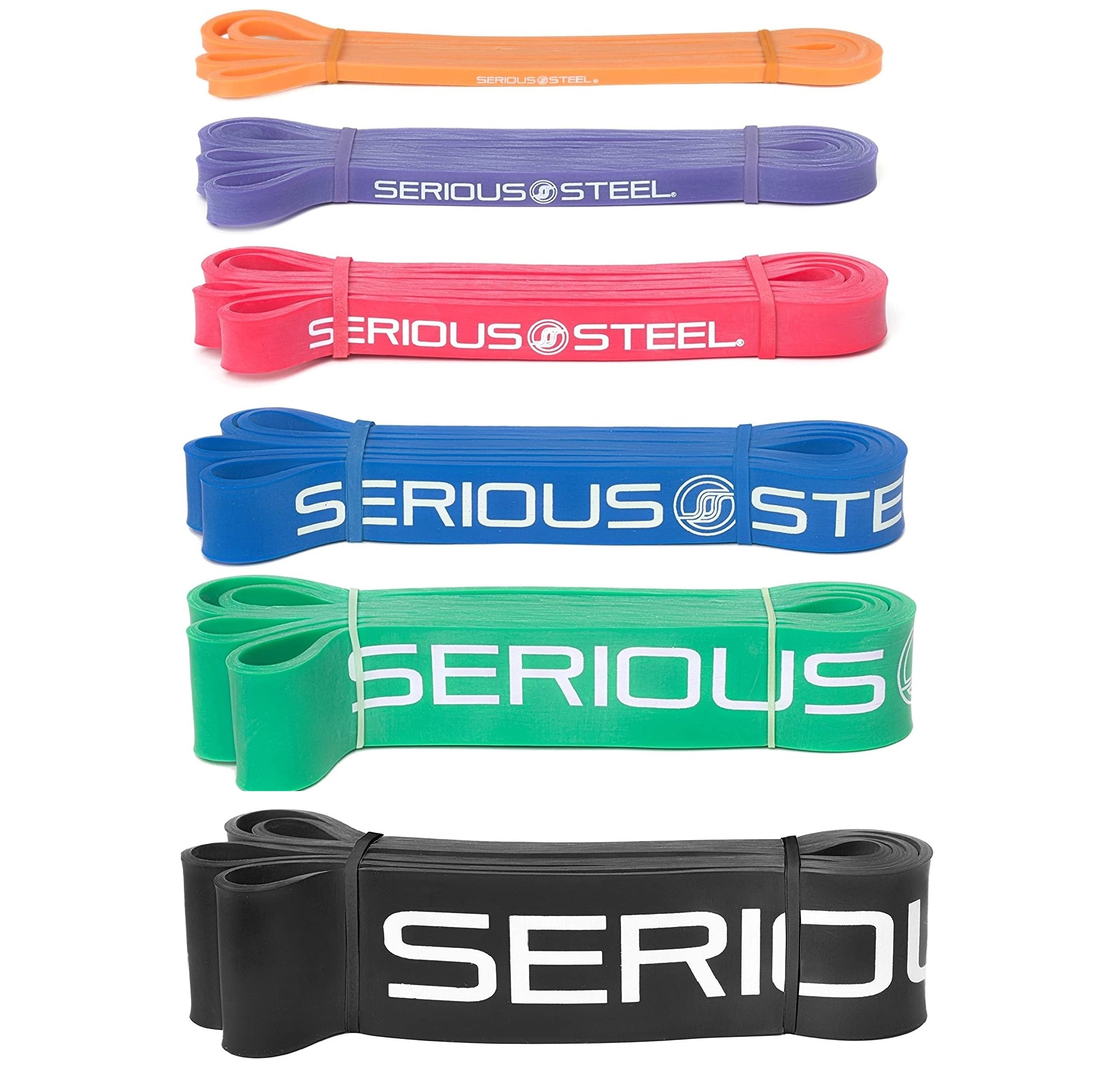
Best for full-body home training, pull-up assistance, banded presses, rows, squats, hinges, and long-term progression.
• 41-inch loop band format works for the widest range of exercises
• Multiple tension levels support progression
• Useful for assisted pull-ups, rows, presses, and lower-body work
• Better strength option than short mini bands
• Portable enough for home, garage, or travel training
Use it for:
- Assisted pull-ups
- Rows
- Chest presses
- Overhead presses
- Good mornings
- Squat variations
- Deadlift patterns
- Banded push-ups
- Stretching and mobility
The advantage is progression. A good loop band set gives you multiple tension levels, so you can use a lighter band for shoulders and a heavier band for rows, squats, or pull-up assistance.
Who it fits: Home users who want one band style for strength, mobility, and full-body home workouts.
Who should skip it: Beginners who prefer handles, door anchors, and a more cable-machine feel.
Best Tube Band Set With Handles
The best tube band set should feel secure under tension. Handles, clips, and the door anchor matter because those parts take most of the stress during rows, presses, and rotational movements.
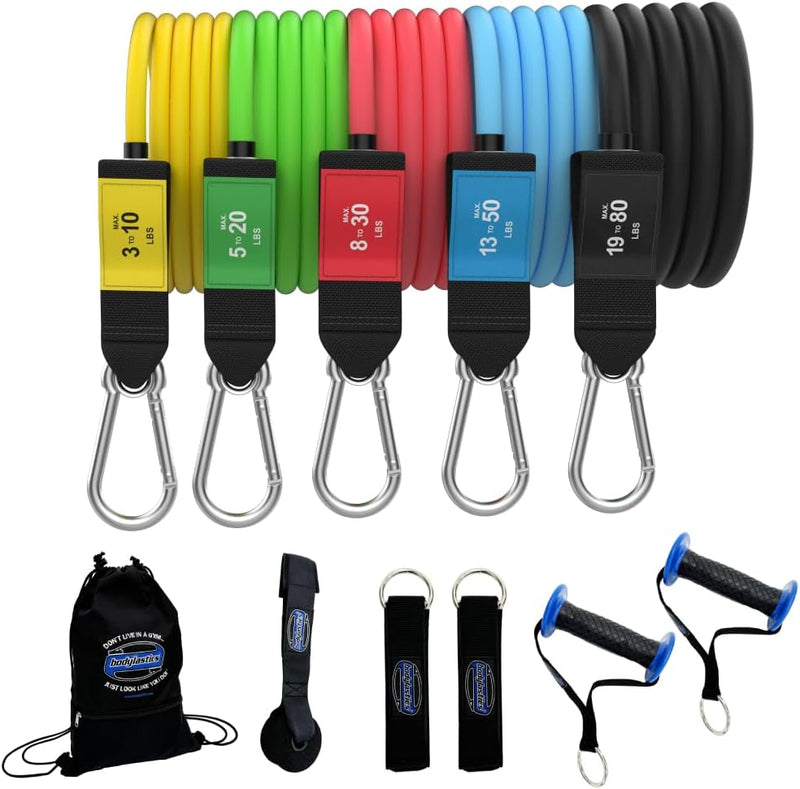
Best for beginner-friendly home workouts with handles, door-anchor movements, rows, presses, curls, and accessory work.
• Includes bands, handles, ankle straps, door anchor, and carry bag
• Stackable tension makes progression easier
• Handles feel natural for curls, rows, presses, and raises
• Better beginner setup than plain loop bands
• Useful for travel or small-space training
Tube bands work well for:
- Curls
- Triceps extensions
- Chest presses
- Rows
- Lateral raises
- Face pulls
- Core rotations
- Ankle-strap exercises
Stackable tube bands are especially useful because you can clip more than one band to the handles and increase resistance gradually.
Who it fits: Beginners, travelers, and people who want a simple home workout setup without learning how to hold loop bands.
Who should skip it: Anyone focused on pull-up assistance, heavy lower-body movements, or barbell-style band training.
Best Budget Mini Band Set
A mini band set should be treated as an accessory tool. The biggest buying mistake is expecting short bands to replace a full-strength setup.

Best low-cost option for warm-ups, glute activation, hip work, light accessory training, and travel.
• Simple five-band set for basic progression
• Small enough for travel or gym bag use
• Useful for glute bridges, lateral walks, clamshells, and warm-ups
• Affordable entry point for beginners
• Works best as an accessory tool, not a full-strength setup
Use mini bands for:
- Lateral walks
- Clamshells
- Glute bridges
- Hip abduction
- Shoulder activation
- Light arm work
- Physical therapy-style movements
For most people, mini bands are best as a warm-up, activation, or travel add-on.
Who it fits: Beginners, people building a warm-up routine, and anyone who wants a low-cost add-on to bodyweight training.
Who should skip it: People who want one tool for full-body strength.
Best Fabric Band Set
Fabric bands solve one of the most annoying problems with thin mini bands: rolling, bunching, and digging into the thighs during lower-body work.

Best for lower-body training, hip work, glute bridges, lateral walks, squats, and warm-up circuits.
• Fabric construction is more comfortable around the thighs
• Less likely to roll than thin latex mini bands
• Available in multiple sizes and resistance levels
• Useful for glute, hip, and lower-body activation work
• Strong choice for warm-ups and finishers
They are useful for:
- Glute bridges
- Hip thrusts
- Lateral walks
- Squat warm-ups
- Abduction work
- Lower-body finishers
The tradeoff is limited versatility. Fabric bands are comfortable and durable for lower-body training, but they are usually poor choices for upper-body pulling, pressing, or long-range strength movements.
Who it fits: People who want a durable lower-body band for glute and hip-focused training.
Who should skip it: Anyone looking for upper-body or full-body band training.
Best Heavy-Duty Band Option
A heavy-duty band should be bought for a clear reason: pull-up assistance, stronger lower-body work, mobility, or band-resisted strength training. Heavy bands can be useful, but they punish sloppy setup faster than lighter bands.
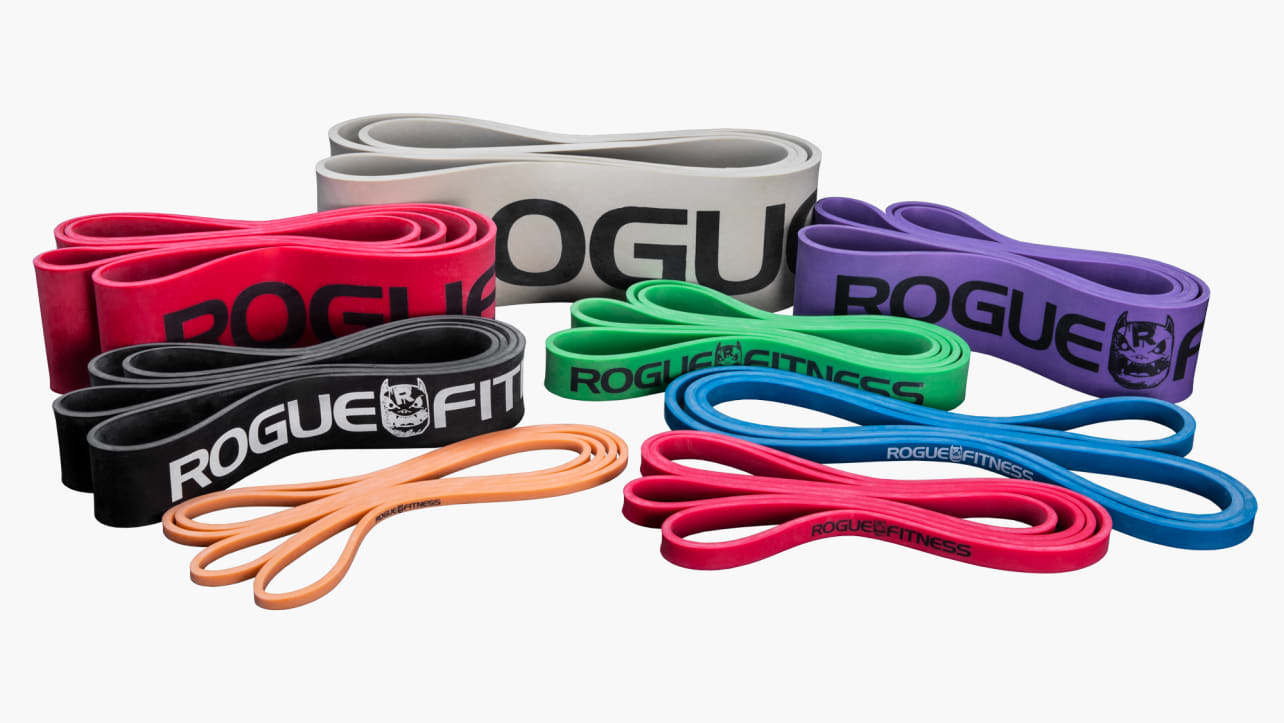
Best for stronger users, pull-up assistance, barbell accessory work, mobility, and higher-tension home gym training.
• 41-inch natural latex loop band format
• Available in multiple resistance levels
• Useful for pull-up assistance, mobility, speed work, and added resistance
• Good fit for garage gyms and stronger users
• Works best when you already understand band setup and safety
The heavier the band, the more setup matters. Heavy bands can snap back hard if anchored poorly or stretched beyond their intended range. Use them with control, inspect them often, and avoid rough surfaces that can damage the material.
Who it fits: Stronger users, pull-up training, home gym owners, and people who want higher resistance options.
Who should skip it: Beginners who have not learned basic band setup yet.
What should you check before buying resistance bands?
Resistance bands look similar online, but small details matter.
Check the band type first. A loop band, tube band, mini band, fabric band, and therapy band are different tools. They overlap in some areas, but each one has a better use case.
Check the tension range. A band that is too light will feel useless for strength work. A band that is too heavy may ruin your technique and shorten your range of motion.
Check the material. Latex bands are common and stretchy, but some people prefer latex-free options. Fabric bands are better for comfort during lower-body work, but they usually do not stretch as far.
Check the length. Full-length loop bands are usually around 41 inches. Mini bands are much shorter and should be treated as a different tool.
Check the accessories. Tube band sets should come with solid handles, ankle straps, and a door anchor. A weak anchor can turn a good band into a bad setup.
Check the return policy and durability notes. Bands wear down over time. Sunlight, heat, rough surfaces, and overstretching can shorten their lifespan.
If you are adding protein to support your training, Fitsnip’s guide on protein and recovery after strength training covers how to approach supplementation without turning it into guesswork.
Coaching check: If the product page does not clearly explain band type, resistance level, length, and intended use, skip it. Confusing specs usually become confusing workouts.
How do you use resistance bands safely at home?
Start by inspecting the band before each workout. Look for small tears, cracks, peeling, weak spots, or thinning. Replace damaged bands instead of trying to squeeze more use out of them.
Anchor bands carefully. If you use a door anchor, place it on a strong door that closes securely. Pull the band gently before the first set to test the setup.
Control the return phase of each rep. Resist the band as it comes back instead of letting it snap you into the starting position. This keeps tension on the muscle and reduces the chance of losing control.
Avoid overstretching. Most bands are designed to stretch, but that does not mean you should pull them to their limit on every rep. Use a stronger band, shorten your stance, or change the angle if you need more resistance.
Protect bands from rough surfaces. Concrete, sharp metal, barbell knurling, and rough floor edges can damage latex bands quickly.
Progress slowly. Add reps first, then add tension, then move to a harder variation. Bands can feel easy at the start of a rep and much harder near the end, so rushing progression can throw off your form.
Are resistance bands enough to build strength at home?
Resistance bands can build strength when the tension is challenging, the exercises are performed through useful ranges of motion, and the plan progresses over time.
A 2019 systematic review and meta-analysis in SAGE Open Medicine found that elastic resistance training produced strength gains similar to conventional resistance training across the studies included.
The 2026 ACSM resistance training update reinforces a practical point: the biggest improvement for many adults comes from moving from no resistance training to consistent resistance training. For a person who trains at home and will actually use bands three times per week, bands can be far more valuable than a gym membership that never gets used.
For more on realistic home training expectations, see Fitsnip’s guide on realistic expectations about exercise and belly fat.
For a broader look at why progressive resistance training matters over the long term, read Fitsnip’s guide on why strength training matters for long-term health.
The key is progression. You need enough resistance to make the final reps challenging while still maintaining control. You also need a plan that includes major movement patterns: squat, hinge, push, pull, carry or brace, and rotational control.
Heavy free weights still have advantages for maximal strength. For home training, travel, warm-ups, joint-friendly accessory work, and consistent strength practice, resistance bands can be highly useful.
Coaching check: Treat bands like real training equipment. Track exercises, reps, sets, and tension level. Random band circuits are better than nothing, but progression is what turns them into strength work.
FAQ
Which resistance band is best for home workout?
For most home workouts, a 41-inch loop band set is the most versatile choice because it works for rows, presses, assisted pull-ups, squats, hinges, and mobility work. Beginners may prefer tube bands with handles because they are easier to grip and use with a door anchor.
Are resistance bands good for home workouts?
Yes. Resistance bands are portable, affordable, and useful for strength training, warm-ups, mobility, and accessory work. They work best when you choose the right band type and increase the tension over time.
Which brand is best for resistance bands?
The best resistance band brand depends on the band type you need. Serious Steel and Rogue are strong options for loop bands, Bodylastics is useful for tube bands with handles, Fit Simplify works for budget mini bands, and BC Strength is a good fabric band option.
Can resistance bands help rotator cuffs?
Resistance bands are commonly used for light shoulder and rotator cuff exercises, but pain or injury should be evaluated by a qualified healthcare professional. Use very light resistance, controlled reps, and stop if symptoms worsen.
Can resistance bands help with osteoporosis?
Resistance training can support muscle and bone health, but osteoporosis requires individualized guidance from a healthcare professional. Resistance bands may be appropriate for some people, especially beginners, but exercise choice and intensity should be cleared by a clinician.
Sources
Lopes JSS, Machado AF, Micheletti JK, de Almeida AC, Cavina AP, Pastre CM. Effects of training with elastic resistance versus conventional resistance on muscular strength: A systematic review and meta-analysis. SAGE Open Medicine. 2019.
https://pmc.ncbi.nlm.nih.gov/articles/PMC6383082/
American College of Sports Medicine. ACSM Publishes Updated Resistance Training Guidelines. 2026.
https://acsm.org/resistance-training-guidelines-update-2026/
American College of Sports Medicine. Science Spotlight: ACSM Releases New Position Stand on Resistance Training. 2026.
https://acsm.org/science-spotlight-acsm-releases-new-position-stand-on-resistance-training/
Serious Steel Fitness. 41" Complete Resistance Band Set.
https://www.serioussteel.com/products/41-band-sets
Bodylastics. 5 Band Set, 3 to 190 lbs Max Tension.
https://bodylastics.com/products/5-band-set-190-lbs-max-tension
Fit Simplify. Resistance Loop Band Exercise Set, Guide, Bag, and Video.
https://www.fitsimplify.com/product/best-resistance-loop-band-set/
Rogue Fitness. Rogue Monster Bands.
https://www.roguefitness.com/rogue-monster-bands
BC Strength. Glute Loop.
https://www.bcstrength.com/products/glute-loop

J.D. Wilson, PN1, is the founder of Fitsnip.com, a Precision Nutrition Level 1 Coach, certified meditation teacher, and author of The Comfort Trap: The Quiet Cost of an Unchallenged Life. His work focuses on practical, evidence-based nutrition, strength training, behavior change, sleep, stress, recovery, and everyday health decisions for adults who want clear guidance without hype. About J.D. Wilson