
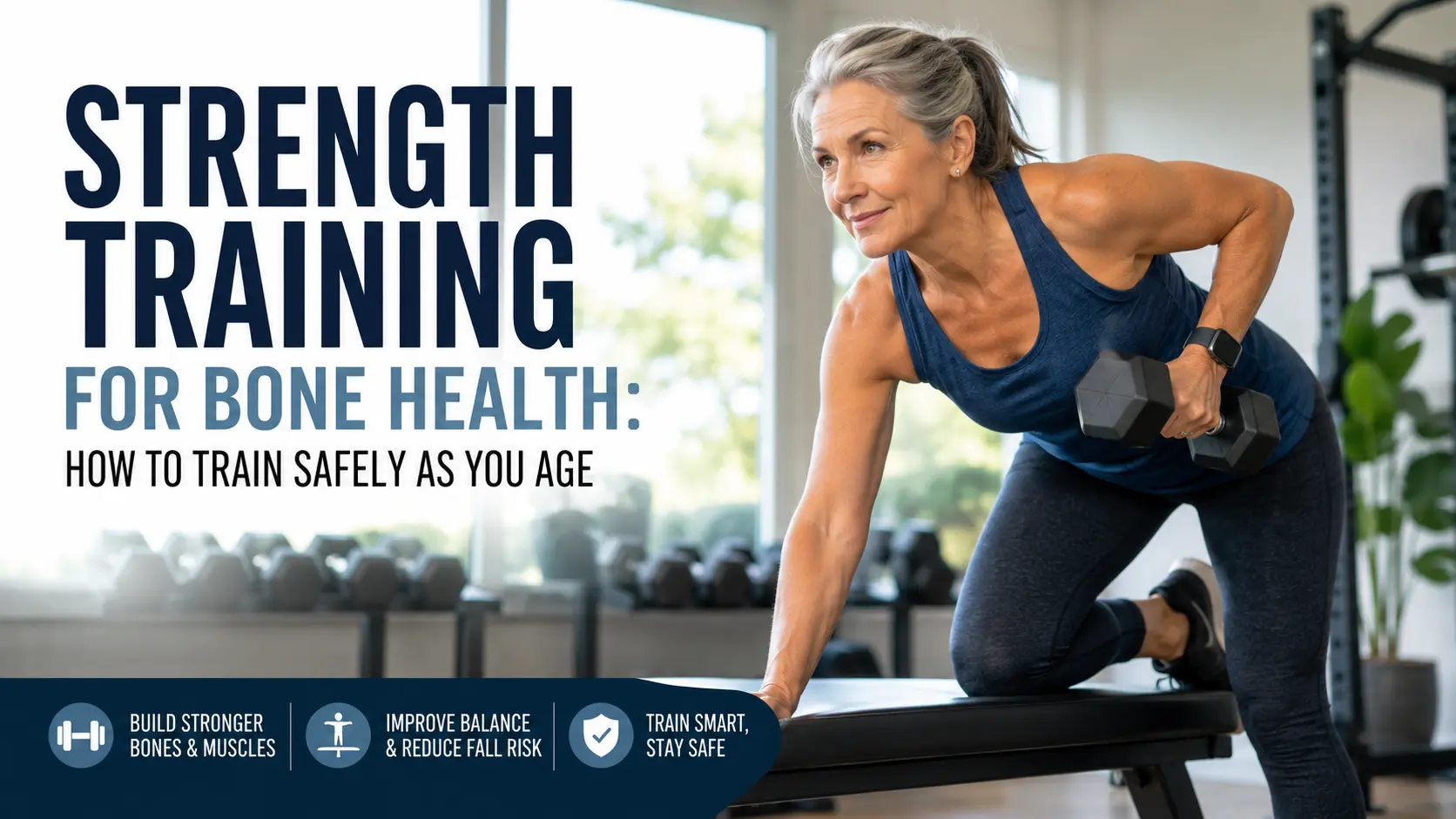
Strength Training for Bone Health: How to Train Safely as You Age
Last reviewed: May 2026
Updated May 2026: This article was substantially rebuilt with updated evidence, clearer structure, and safer practical guidance. The original publish date is preserved in the article record.
This content is for informational purposes only and is not a substitute for professional medical advice, diagnosis, or treatment. Always consult a qualified healthcare provider before making changes to your diet, supplement routine, or exercise program.
Our articles follow the Fitsnip research process and editorial policy.
Quick Summary
Strength training supports bone health by giving bones a reason to adapt. A complete plan includes progressive resistance training, weight-bearing movement, and balance work. For most adults, two strength sessions per week is a strong baseline. People with osteoporosis or high fracture risk should get individualized guidance before lifting heavy.
Jump to Sections
- How strength training helps bone health
- Bone Strength Triangle
- Does strength training increase bone density?
- Best strength exercises for bone health
- How often should you strength train for bone health?
- Is walking enough for bone health?
- Safety if you have osteoporosis or high fracture risk
How strength training helps bone health
Strength training helps bone health by placing controlled force through bones and muscles. That force signals bone tissue to maintain or build strength, especially when training becomes gradually more challenging. For most adults, two weekly strength sessions built around major movement patterns is a strong starting point.
Bone is living tissue. It is constantly being broken down and rebuilt. The National Institute of Arthritis and Musculoskeletal and Skin Diseases says exercise can support bone health by helping prevent bone loss, improve balance, and reduce fall and fracture risk.
That is why bone-focused training should include more than one kind of movement. NIAMS points to resistance training, weight-bearing exercise, and balance training as useful categories for building and maintaining healthy bones.
Resistance training can include dumbbells, barbells, machines, resistance bands, kettlebells, weighted carries, or bodyweight exercises. The tool matters less than the signal. Bones and muscles need enough challenge to adapt, but the challenge has to fit the person.
A review in Endocrinology and Metabolism explains that resistance exercise can help preserve both bone and muscle mass as people age. That connection matters. Bone health is partly about the skeleton, but it also depends on the muscle, coordination, posture, and strength that help a person move well enough to protect that skeleton.
For a wider view of exercise beyond the scale, Fitsnip’s guide to exercise benefits beyond weight loss explains why strength, blood pressure, blood sugar, sleep, mood, mobility, and long-term function deserve more attention than body weight alone.
The practical aim is simple: repeatable loading, clean technique, and progression that your body can recover from.
Bone Strength Triangle
Bone-health training is strongest when it includes three pieces: load, muscle, and balance. Many people focus on one and miss the system.
1. Load
Bones need force. That force can come from lifting weights, using resistance bands, climbing stairs, walking briskly, carrying weight, or doing appropriate impact exercise.
The Royal Osteoporosis Society explains that bone-strengthening activity includes both weight-bearing impact exercise and muscle-strengthening exercise. That gives us the first practical lesson: bones respond when they are given work to do.
Load also needs progression. A chair squat may be challenging for someone who is just starting. Later, that same person may need a goblet squat, leg press, split squat, weighted step-up, or another harder variation. Bones respond best when the challenge grows gradually.
2. Muscle
Muscle is part of the bone-health system. Stronger muscles pull on bones, support joints, improve posture, and help the body handle daily tasks with more control.
That becomes more important with age. Losing strength can make stairs, carrying groceries, standing from a chair, and catching yourself during a stumble more difficult. Mayo Clinic notes that strength training can strengthen muscles, tendons, and bones, while back-strengthening work can support posture.
Strength also connects to independence. Fitsnip’s guide on strength training and longevity covers why muscle and strength become more valuable as people age.
3. Balance
A stronger skeleton still needs a body that can avoid falls. For older adults, balance work is part of bone protection.
NIAMS includes balance training as part of a bone-health routine because it can improve balance and help prevent falls. Examples include tai chi, step-ups, lunges, walking backward, and shifting body weight while standing.
The CDC’s older-adult activity guidance also includes aerobic activity, muscle-strengthening activity, and balance activity each week.
Coaching check: If your program builds strength but never trains stepping, balance, or single-leg control, it leaves a major piece of bone protection undertrained.
Does strength training increase bone density?
Strength training can help maintain or improve bone mineral density, but results vary. Age, sex, hormone status, baseline bone density, training history, nutrition, exercise intensity, and the bone site being measured all affect the outcome.
Bone-density claims need restraint. A fixed claim like “strength training increases bone density by 1 to 3 percent per year” is too broad unless the source, population, training plan, and measurement site are clearly stated.
The more accurate answer is that resistance training can support bone mineral density when it is progressive, consistent, and challenging enough to create an adaptation signal.
A 2022 meta-analysis on resistance training and bone mineral density in older adults found that resistance-training protocols can promote changes in bone mineral density. That does not mean every program works the same way. It means strength training has a meaningful place in a serious bone-health plan.
A 2025 meta-analysis in Journal of Orthopaedic Surgery and Research found that resistance training can positively influence bone mineral density in postmenopausal women, especially at the lumbar spine, femoral neck, and total hip. The authors also noted meaningful heterogeneity, so the findings should not be turned into one-size-fits-all exercise instructions.
High-intensity research is promising, but it needs context. In the LIFTMOR trial, a supervised high-intensity resistance and impact program improved bone-related and physical performance measures in postmenopausal women with low bone mass. The important word is supervised. That study should not be read as permission for every person with low bone density to start heavy lifting or impact training alone.
The practical takeaway is measured: light movement is useful, progressive resistance is more specific to bone and muscle, and heavy or high-impact training should be built carefully when fracture risk is elevated.
Best strength exercises for bone health
The best strength exercises for bone health load major muscle groups, train real movement patterns, and allow safe progression over time.
A strong program is usually built from squats, hinges, pushes, pulls, step patterns, carries, and balance drills. You do not need to master every exercise at once. You need a small set of movements you can perform well, recover from, and progress over time.
Squat pattern
Useful options include:
- Chair squats
- Box squats
- Goblet squats
- Split squats
- Leg presses
- Supported squat variations
Squat patterns train the hips and legs. They also support daily tasks like standing from a chair, climbing stairs, and getting down to or up from the floor.
Hinge pattern
Useful options include:
- Hip hinges
- Romanian deadlifts
- Kettlebell deadlifts
- Trap-bar deadlifts
- Glute bridges
- Cable pull-throughs
Hinge training builds the hips, glutes, hamstrings, and backside strength. It also teaches people to bend through the hips with more control.
Push pattern
Useful options include:
- Wall push-ups
- Incline push-ups
- Dumbbell presses
- Machine chest presses
- Landmine presses
- Resistance-band presses
Pushing exercises train the chest, shoulders, arms, and upper body. They can also load the wrists and arms in ways that walking does not.
Pull pattern
Useful options include:
- Band rows
- Cable rows
- Chest-supported dumbbell rows
- Pulldowns
- Assisted pull-ups
- Machine rows
Pulling exercises support upper-back strength and posture. The upper back often gets neglected in basic fitness routines, but it matters for posture, shoulder control, and how the body carries load.
Step and lunge pattern
Useful options include:
- Step-ups
- Supported reverse lunges
- Split squats
- Stair climbing
- Lateral step work
Step and lunge patterns train leg strength and balance together. Scale these movements carefully if balance, knee pain, or hip pain is an issue.
Carry pattern
Useful options include:
- Farmer carries
- Suitcase carries
- Front carries
- Light-loaded walks
Carries train grip, posture, trunk control, and whole-body strength. They are simple, practical, and easy to scale.
Balance pattern
Useful options include:
- Supported single-leg stands
- Tandem stance
- Heel-to-toe walking
- Slow step-ups
- Backward walking
- Tai chi
Balance drills should start simple. Use a wall, counter, railing, or stable surface when needed.
The Royal Osteoporosis Society uses a similar movement-pattern approach, grouping bone-strengthening movements around hinge, push, pull, squat, brace, lunge, and step patterns.
A simple session could include:
- One squat pattern
- One hinge pattern
- One push pattern
- One pull pattern
- One step, carry, or balance drill
That is enough for many adults to start.
Equipment note: This article is not a push to buy anything. If you train at home, choose equipment that lets you load movements safely and progressively. Fitsnip’s guide to the best resistance bands can help if bands fit your current setup better than dumbbells or machines.
How often should you strength train for bone health?
Most adults should strength train at least two days per week.
The CDC recommends two or more days of muscle-strengthening activity per week for adults 65 and older, along with balance activity. The Physical Activity Guidelines for Americans also recommend muscle-strengthening activities involving all major muscle groups on two or more days per week.
For bone-health-focused strength training, twice weekly is a strong baseline. Three weekly sessions may help people who recover well, enjoy lifting, and want more practice. The program still needs rest days, good technique, and gradual progression.
Beginner weekly structure
- Two strength sessions per week
- Two to four walks or other weight-bearing movement sessions per week
- Two short balance sessions per week
Intermediate weekly structure
- Two or three strength sessions per week
- Two or three weight-bearing cardio sessions per week
- Two or three short balance drills per week
Older adult or higher-risk weekly structure
- Two strength sessions per week, adjusted to ability
- Low-impact weight-bearing activity as tolerated
- Short balance practice during the week
- Professional guidance when osteoporosis, recent fracture, or high fall risk is present
Exercise is Medicine says people with osteoporosis or osteopenia should talk with their healthcare team before starting a new exercise program. It also notes that a physical therapist or certified exercise professional with bone-health expertise can help design a customized plan.
Coaching check: The right load feels challenging but controlled. If pain changes your movement, technique breaks down, or recovery falls apart, the load is too aggressive for now.
Is walking enough for bone health?
Walking is valuable. It supports heart health, blood sugar regulation, mood, consistency, and daily movement. It is also a low-impact weight-bearing activity.
The Bone Health & Osteoporosis Foundation lists brisk walking as a low-impact weight-bearing exercise that can help keep bones strong.
Walking has limits for bone and muscle. A person who already walks often may not get enough new loading from walking alone to build stronger muscle and bone over time. The body adapts to familiar stress. Many adults eventually need progressive resistance, stair climbing, hills, loaded carries, or structured strength training.
A better plan for most people is walking plus strength training. Walking builds the habit of movement. Strength training builds physical reserve.
Safety if you have osteoporosis or high fracture risk
People with diagnosed osteoporosis, osteopenia, recent fractures, spinal fractures, unexplained bone pain, high fall risk, or major joint limitations should get individualized guidance before lifting heavy or adding impact exercise.
Mayo Clinic’s guidance on exercising with osteoporosis says people with more advanced osteoporosis may have a high risk of broken bones and should ask a healthcare provider or physical therapist what exercises are safe. Mayo also cautions that high-impact exercise and bending or twisting at the waist may increase risk for some people with osteoporosis.
The Bone Health & Osteoporosis Foundation also cautions that high-impact exercise may be inappropriate for people who have broken a bone due to osteoporosis or are at increased fracture risk.
A physical therapist, qualified clinical exercise physiologist, or healthcare provider can recommend specific modifications based on bone density, fracture history, balance, pain, medication use, and movement tolerance.
Stop training and get qualified guidance if you notice sharp pain, dizziness, numbness, unusual back pain, new symptoms, or pain that changes your movement.
Strength training is one of the most practical tools for supporting bone health as you age. Build from movements you can control. Train major muscle groups at least twice per week. Keep walking and other weight-bearing movement in your life. Add balance work, especially if you are older, returning to exercise, or worried about falls.
The aim is a body that can carry weight, absorb force, move with control, and stay capable for decades.
FAQ
Is lifting weights good for bone health?
Yes. Lifting weights can support bone health because resistance training places controlled stress on bones and muscles. The best results usually come from progressive training that becomes gradually harder while staying safe.
Does strength training increase bone density?
Strength training can help maintain or improve bone mineral density, but results vary. Age, sex, baseline bone density, training intensity, nutrition, hormones, consistency, and the specific bones measured all matter.
What strength exercises are best for bone health?
Useful exercises usually include squats, hinges, rows, presses, step-ups, lunges, carries, and controlled bodyweight movements. The best choice depends on strength, balance, injury history, and bone-health status.
How often should you strength train for bone health?
Most adults should strength train at least two days per week. Older adults should also include balance work. More training can help some people when recovery, technique, and progression are managed well.
Can strength training help if you have osteoporosis?
Strength training may help some people with osteoporosis, but the plan should be individualized. Ask a healthcare provider, physical therapist, or qualified exercise professional what exercises are safe for your fracture risk.
Is walking enough to protect bone health?
Walking is useful, but walking alone may not provide enough progressive loading for full bone and muscle support. Most adults benefit from combining walking with strength training and balance work.
Are resistance bands enough for bone health?
Resistance bands can be a good starting point, especially for beginners or home workouts. Over time, bone and muscle usually need progressive challenge from stronger bands, harder movements, free weights, machines, or supervised loading.
Sources
National Institute of Arthritis and Musculoskeletal and Skin Diseases. “Exercise for Your Bone Health.” Last reviewed May 2023. NIAMS
Centers for Disease Control and Prevention. “Older Adult Activity: An Overview.” CDC
U.S. Department of Health and Human Services. “Physical Activity Guidelines for Americans, 2nd edition.” Health.gov
Hong AR, Kim SW. “Effects of Resistance Exercise on Bone Health.” Endocrinology and Metabolism. 2018. PMC
Massini DA, Nedog FH, de Oliveira TP, et al. “The Effect of Resistance Training on Bone Mineral Density in Older Adults: A Systematic Review and Meta-Analysis.” Healthcare. 2022. PubMed
Zhao F, Su W, Sun Y, Wang J, Lu B, Yun H. “Optimal resistance training parameters for improving bone mineral density in postmenopausal women: a systematic review and meta-analysis.” Journal of Orthopaedic Surgery and Research. 2025. Springer Nature
Watson SL, Weeks BK, Weis LJ, Harding AT, Horan SA, Beck BR. “High-Intensity Resistance and Impact Training Improves Bone Mineral Density and Physical Function in Postmenopausal Women With Osteopenia and Osteoporosis: The LIFTMOR Randomized Controlled Trial.” Journal of Bone and Mineral Research. 2018. PubMed
Royal Osteoporosis Society. “Exercise for bones.” Royal Osteoporosis Society
Royal Osteoporosis Society. “How to build up exercise for your bone strength.” Royal Osteoporosis Society
Bone Health & Osteoporosis Foundation. “Weight-Bearing and Muscle-Strengthening Exercises.” BHOF
Mayo Clinic. “Exercising with osteoporosis: Stay active the safe way.” Mayo Clinic
Exercise is Medicine. “Being Active When You Have Osteoporosis.” Exercise is Medicine

J.D. Wilson, PN1, is the founder of Fitsnip.com, a Precision Nutrition Level 1 Coach, certified meditation teacher, and author of The Comfort Trap: The Quiet Cost of an Unchallenged Life. His work focuses on practical, evidence-based nutrition, strength training, behavior change, sleep, stress, recovery, and everyday health decisions for adults who want clear guidance without hype. About J.D. Wilson