How Does Stress Affect Sleep? Recovery, Cravings, and Training
By J.D. Wilson, PN1
Last reviewed: June 2026
Stress does not replace medical care. If sleep problems are severe, persistent, or connected to anxiety, depression, trauma, medication changes, pain, breathing issues, or other symptoms, talk with a qualified healthcare professional.
At Fitsnip, health articles are built from source review, practical coaching judgment, and clear evidence ranking. Read more in our How We Research process.
Quick Summary
Stress, poor sleep, cravings, and hard training can feed the same loop. The pattern often starts with high alertness at night, then shows up the next day as weaker recovery, stronger food urges, lower discipline, and workouts that feel heavier than they should.
Jump to Sections
- How stress affects sleep
- The Stress-Sleep Loop
- Why stress can increase cravings
- How stress affects workout recovery
- Where to break the loop first
- FAQ
How stress affects sleep
Stress affects sleep by disrupting the body’s normal nighttime downshift. Cortisol usually drops toward its daily low at night, supporting sleep onset and overnight recovery. Chronic stress can keep the HPA axis partially activated, leaving the body tired but alert. In active adults, that can carry into stronger cravings, slower recovery, and harder training the next day.
Cortisol is one of the body’s main stress hormones, but it is also part of normal daily physiology. It helps mobilize energy, increase alertness, and support the wake cycle. Under healthy conditions, cortisol tends to rise in the morning and decline later in the day. A 2021 review on sleep and circadian regulation of cortisol explains that cortisol is shaped by both sleep timing and circadian rhythm.
That rhythm matters at night. Sleep onset becomes easier when the body shifts away from daytime alertness. Chronic stress can interfere with that shift through the hypothalamic-pituitary-adrenal axis, often called the HPA axis. This system helps coordinate the stress response. When it stays active late in the day, the body can remain prepared to react even when the person wants to rest.
A review in Sleep Science describes stress as a major link between sleep and metabolism through HPA-axis activation. A separate review on stress and sleep reactivity describes sleep reactivity as the degree to which stress exposure disrupts sleep, including trouble falling asleep and staying asleep.
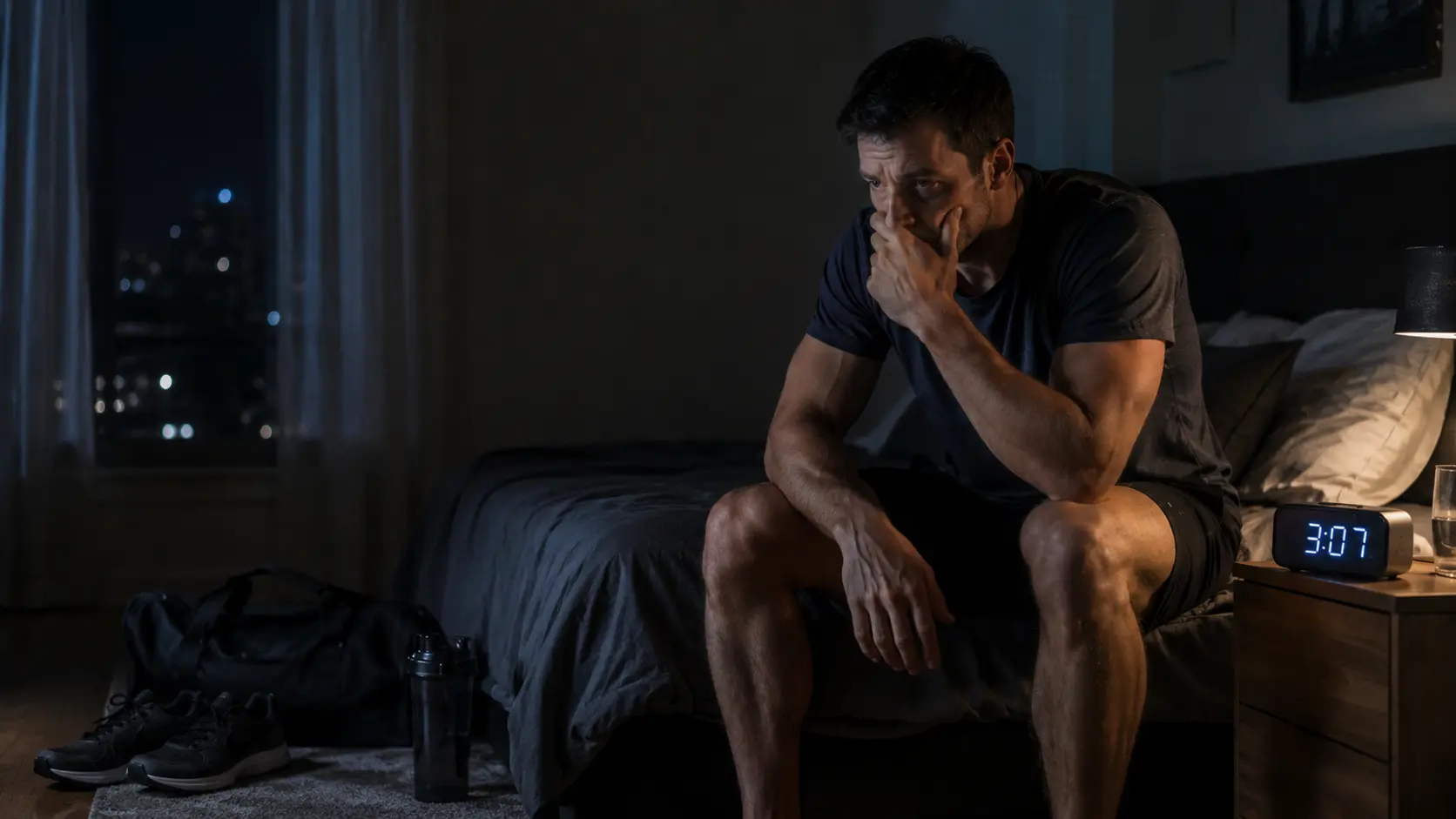
This is the “tired but wired” pattern. You may feel physically drained after work, training, family stress, or a long day, yet your mind stays active when the room gets quiet. Sleep feels close, but the system remains too alert to settle.
Stress-disrupted sleep often shows up as racing thoughts at bedtime, waking during the night with a busy mind, light sleep that feels easy to disturb, stronger cravings the next day, and workouts that feel unusually heavy. One stressful night is normal. The problem begins when poor sleep and high stress start reinforcing each other.
The Stress-Sleep Loop
The Stress-Sleep Loop connects sleep, appetite, training, and recovery.
Stress raises alertness and stress hormones
↓
Sleep becomes lighter, shorter, or harder to start
↓
Recovery drops and cravings rise
↓
Training feels harder and discipline slips
↓
Stress builds again the next day
The useful question is: where are you entering the loop?
Entry point: racing thoughts at bedtime
This entry point usually signals unresolved cognitive load. The day is still open in the mind. Tasks, conversations, bills, training plans, family stress, or work problems keep replaying because the brain is still trying to sort them.
Sleep responds poorly to unfinished loops. Bedtime turns into planning time, threat-scanning time, or regret-review time. The body is horizontal, but the system is still working.
Entry point: waking during the night
This usually signals fragile sleep maintenance. The person may fall asleep, then wake around the same time or drift in and out of shallow sleep.
Several inputs can make sleep more fragile: stress, late caffeine, alcohol, inconsistent wake times, intense evening work, hard training too late, or going to bed underfed. The pattern does not automatically mean a sleep disorder, but it does show that the night is easier to disturb.
Entry point: cravings in the afternoon or evening
This entry point often signals recovery debt. The brain is looking for fast reward and fast energy.
For people who train, cravings are easy to misread as a willpower problem. Often, the pattern is more physiological. Stress and poor sleep can push appetite and reward signals toward sweet, salty, fatty, or easy-to-overeat foods.
Entry point: poor workout recovery
This entry point signals that total load may be higher than recovery capacity.
Training is a stressor when the dose fits. Work stress, life stress, calorie restriction, poor sleep, and hard workouts all add to the body’s total recovery demand. When that demand stays high, workouts can feel heavier even when the program has not changed.
Entry point: wired but exhausted
This entry point shows fatigue and arousal happening at the same time.
The person feels too tired to train well, too stimulated to sleep deeply, too hungry to make steady food choices, and too tense to relax. More pressure usually feeds the loop. The better move is to find the first controllable entry point.
Why stress can increase cravings
Stress cravings are biological, behavioral, and environmental at the same time. The biology matters because it explains why cravings often get louder when sleep gets worse.
Cortisol interacts with appetite and reward pathways. Ghrelin, often called a hunger hormone, also influences food motivation and reward. Leptin helps signal energy availability and satiety. When stress and poor sleep disturb these signals, high-reward foods can become harder to ignore.
A six-month prospective study in Obesity examined stress, cortisol, ghrelin, leptin, insulin, food cravings, and weight change. The authors found that stress, cortisol, and appetite-related hormones were connected to food cravings and weight change patterns, with ghrelin playing a notable role in reward-driven eating behavior.
A review on stress and eating behaviors also describes how uncontrollable stress can increase the appeal and intake of hyperpalatable foods. These are foods that combine strong reward signals such as sugar, fat, salt, crunch, and easy calories.
That matters because cravings under stress usually have a pattern. Many people do not crave plain chicken, lentils, or raw broccoli when they are underslept and overwhelmed. They crave foods that deliver fast reward.
For an active adult, the chain is easy to recognize. Stress keeps the body alert at night. Sleep gets shorter or lighter. Appetite and reward signals get louder. Evening food choices become less stable. Recovery suffers, training feels harder, and the next day starts with a higher stress load.
This is where nutrition advice can get too simplistic. Telling a stressed, underslept person to “just have discipline” misses the mechanism. A tired nervous system with unstable meals and high training demand will usually look for relief somewhere.
The practical move is to stabilize the day before cravings peak.
Start with dinner. A real dinner with protein, fiber, and slow-digesting carbohydrates gives the body a steadier base. This is especially important for people who train, walk a lot, work physical jobs, or tend to under-eat during stressful days.
Useful dinner patterns include eggs with potatoes and fruit, Greek yogurt with berries and oats, chicken with rice and beans, beef with sweet potato and salad, or cottage cheese with toast and cinnamon. The exact meal can vary. The pattern is what matters: enough food, enough protein, enough fiber, and enough structure before the late-night craving window opens.
Protein matters here because it supports satiety and recovery. If getting enough protein is difficult, a practical resource like Protein Powder for Men Over 40 can help with the basics. The larger principle is meal structure: steady intake beats late-night damage control.
Cravings should be treated as data. They may reflect stress, sleep loss, under-eating, habit, environment, or all of those at once. Reading the signal gives you more leverage than judging it.
How stress affects workout recovery
Stress affects workout recovery because adaptation happens between sessions. Training gives the body a reason to adapt. Sleep, nutrition, and recovery time create the conditions for that adaptation.
A study in the Journal of Strength and Conditioning Research examined whether chronic psychological stress affected recovery after strenuous resistance exercise. The researchers tracked muscular function and somatic sensations over 96 hours and found that higher chronic stress was associated with poorer recovery of muscular function and sensations such as energy, fatigue, and soreness.
That finding fits real training experience. During high-stress seasons, familiar workouts may feel unusually heavy. Soreness may last longer. Motivation may drop. The same program that felt productive three weeks earlier may suddenly feel like a grind.
Sleep is one of the strongest recovery levers in that equation.
A small human study in Physiological Reports tested the effect of one night of total sleep deprivation in healthy young adults. The researchers found that acute sleep deprivation reduced skeletal muscle protein synthesis and promoted a more catabolic hormonal environment. The sample included 13 participants, so the study should be read as mechanistic human evidence rather than a final rule for every athlete. Still, the signal is important: sleep loss can affect the actual rebuilding environment.
Precision matters here.
Stress is rarely a simple on/off switch for muscle growth. Chronic stress can interfere with the conditions that support muscle growth: sleep quality, appetite regulation, recovery between sessions, training consistency, and anabolic-catabolic balance.
For the person training hard, the lesson is practical. When stress and sleep are poor, the smartest training adjustment is often dose control. You can keep the training habit while lowering the recovery cost: reduce total sets, stop farther from failure, move the hardest lift to a better-recovered day, replace intervals with Zone 2 cardio or walking, keep technique work, or take one extra rest day before the heaviest session.
Strength still matters. Muscle and strength are major long-term health assets, which is why Strength Training and Longevity is one of the core Fitsnip fitness guides. The point here is that recovery belongs inside the program. A hard workout is only productive if the body can adapt to it.
Exercise can also reduce stress when the dose matches the person’s current recovery state. Exercise Benefits Beyond Weight Loss covers that broader role of movement. A heavy lifting session, a walk, and a light mobility day can all support health, but they do not ask the same thing from the body.
Where to break the loop first
Pick the entry point that is most obvious right now. One clean break point can weaken the whole loop.
If racing thoughts start at bedtime
Close the day before bed.
Try this:
- Write tomorrow’s first three tasks on paper.
- Put one unresolved worry into a note instead of rehearsing it.
- Dim lights during the final hour.
- Keep hard planning out of bed.
- Repeat the same short wind-down routine for seven nights.
The aim is to reduce open loops before the room gets quiet.
If you wake during the night
Anchor the day earlier.
Start with:
- A consistent wake time
- Morning light exposure
- Caffeine earlier in the day
- Less alcohol near bedtime
- A real dinner
- Stress unloading before the final hour of the night
Wake time is powerful because it gives the body a daily anchor. Morning light and consistent timing help reinforce the rhythm that makes nighttime sleep easier.
If cravings hit hard
Stabilize food before the craving window.
Try this:
- Eat enough earlier in the day.
- Include protein at dinner.
- Add fiber from fruit, vegetables, beans, or whole grains.
- Keep one easy evening option available.
- Avoid turning one snack into a spiral.
A craving can carry useful information. It may point to stress, sleep loss, skipped meals, hard training, or a food environment that needs adjusting.
If workouts feel unusually hard
Adjust training load for a short block.
Try this:
- Cut one or two sets per exercise.
- Reduce intensity for several sessions.
- Use walking on recovery days.
- Avoid failure training when sleep is poor.
- Take one extra rest day before the heaviest workout.
Walking works especially well during high-stress periods because it provides movement with a low recovery cost. Walking for Longevity explains why walking deserves more respect than it usually gets.
If stress is high and movement is low
Use easy movement as the first lever.
A 10-minute walk after a meal can change the direction of a day. So can stepping outside in the morning, taking a short walk before work, or adding movement breaks between long sitting blocks.
The Daily Movement Benefits guide explains why small movement patterns matter. During high-stress seasons, easy movement can help reconnect sleep, appetite, and training without adding another major recovery demand.
FAQ
Does stress affect sleep quality?
Yes. Stress can reduce sleep quality by keeping the body in a higher-alert state. It can make sleep lighter, delay sleep onset, increase nighttime waking, and reduce the feeling of overnight recovery.
How do you sleep when stressed?
Lower arousal before bed. Write down tomorrow’s first tasks, dim lights, keep caffeine earlier, avoid hard planning late, and repeat a simple routine. Persistent sleep problems should be discussed with a qualified healthcare professional.
What hormone does stress release that affects sleep?
Cortisol is one major stress hormone involved. It normally follows a daily rhythm and tends to be lower at night. Chronic stress can disrupt that downshift by keeping the HPA axis more active.
Does stress affect workout recovery?
Yes. Chronic psychological stress can impair recovery after strenuous resistance exercise. Poor sleep can also reduce muscle protein synthesis and shift the body toward a more catabolic recovery environment.
Why do I crave junk food when stressed?
Stress can affect appetite and reward pathways. Cortisol, ghrelin, leptin, sleep loss, and mental fatigue can push cravings toward sweet, salty, fatty, and highly rewarding foods.
Can stress stop muscle growth?
Stress is rarely a simple on/off switch for muscle growth. Chronic stress can interfere with the conditions that support growth, including sleep quality, appetite, recovery, training consistency, and anabolic-catabolic balance.
Sources
- Hirotsu C, Tufik S, Andersen ML. Interactions between sleep, stress, and metabolism: From physiological to pathological conditions. Sleep Science. 2015. DOI: 10.1016/j.slsci.2015.09.002.
- O’Byrne NA, Yuen F, Butt W, Liu PY. Sleep and Circadian Regulation of Cortisol: A Short Review. Current Opinion in Endocrine and Metabolic Research. 2021.
- Kalmbach DA, Anderson JR, Drake CL. The impact of stress on sleep: Pathogenic sleep reactivity as a vulnerability to insomnia and circadian disorders. Journal of Sleep Research. 2018.
- Chao AM, Jastreboff AM, White MA, Grilo CM, Sinha R. Stress, cortisol, and other appetite-related hormones: Prospective prediction of 6-month changes in food cravings and weight. Obesity. 2017.
- Yau YHC, Potenza MN. Stress and Eating Behaviors. Minerva Endocrinologica. 2013.
- Lamon S, Morabito A, Arentson-Lantz E, et al. The effect of acute sleep deprivation on skeletal muscle protein synthesis and the hormonal environment. Physiological Reports. 2021. DOI: 10.14814/phy2.14660.
- Stults-Kolehmainen MA, Bartholomew JB, Sinha R. Chronic psychological stress impairs recovery of muscular function and somatic sensations over a 96-hour period. Journal of Strength and Conditioning Research. 2014.

J.D. Wilson, PN1, is the founder of Fitsnip.com, a Precision Nutrition Level 1 Coach, certified meditation teacher, and author of The Comfort Trap: The Quiet Cost of an Unchallenged Life. His work focuses on practical, evidence-based nutrition, strength training, behavior change, sleep, stress, recovery, and everyday health decisions for adults who want clear guidance without hype. About J.D. Wilson