Google Fitbit Air Is Official: Price, Features, and Who It Fits
Last updated: May 7, 2026
Updated May 2026: Google has officially announced Fitbit Air. This article has been updated with confirmed pricing, preorder details, release timing, features, subscription costs, compatibility, and the role of the new Google Health app.
This article is for informational purposes only. Wearable health data can help you notice patterns, but it is not a medical diagnosis or a replacement for professional medical advice.
Quick Summary
Google Fitbit Air is official: a $99.99 screenless tracker with 7-day battery, AFib alerts, sleep tracking, and Google Health app pairing. Preorders are open now. It ships May 26 and includes a three-month Google Health Premium trial. Best fit: people who want passive recovery data without a smartwatch.
Jump to Sections
- What Google announced
- Price, preorder deals, and bands
- Confirmed Fitbit Air specs and tracking features
- Google Health Premium and AI Coach
- Fitbit Air vs Whoop
- Who should consider Fitbit Air?
- FAQ
Our articles follow the Fitsnip research process and editorial policy.
What Google announced
Google has officially introduced the Fitbit Air, a screenless fitness tracker built around comfortable all-day wear, passive health tracking, sleep data, and the new Google Health app.
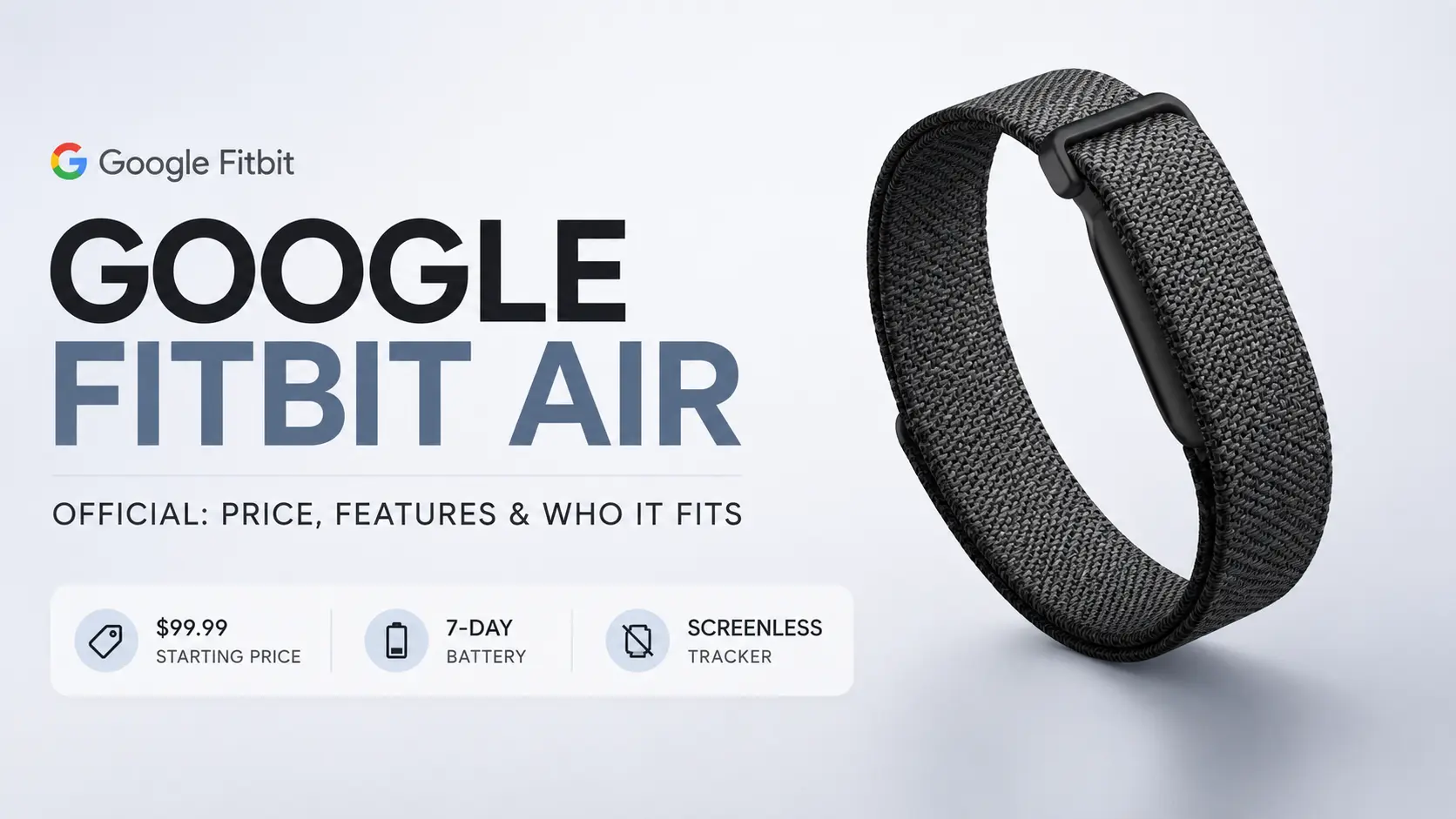
The announcement changes the article completely. Fitbit Air is now a confirmed product, available for preorder at $99.99, with a three-month Google Health Premium trial included. Google describes it as its smallest and most affordable tracker, designed for 24/7 health monitoring in a small screenless pebble. Google’s official Fitbit Air announcement
Fitbit Air drops the smartwatch playbook. There is no display, notification center, app drawer, music controls, or watch face. It collects data quietly and pushes the explanation into the Google Health app.
That makes the device interesting for people who already wear an analog watch, dislike smartwatch notifications, want a lighter sleep tracker, or need passive health data without another screen on the wrist.
WIRED reports that the Fitbit app will become Google Health through an app update on May 19, with Fitbit Air launching May 26. WIRED: Google Health app
This also puts Fitbit Air inside a bigger Google strategy. The device is the sensor. Google Health is the dashboard. Google Health Coach is the AI layer that tries to turn the data into guidance.
Price, preorder deals, and bands
Fitbit Air starts at $99.99 in the United States. Google lists the tracker for preorder now, with the standard version and the Stephen Curry Special Edition both available at launch. Google Store: Fitbit Air
The launch pricing and preorder details are:
- Standard Fitbit Air: $99.99
- Stephen Curry Special Edition: $129.99
- Three-month Google Health Premium trial included
- $35 Google Store credit after the order ships, ending May 25
- Eligible trade-in can bring the preorder price as low as $0, ending May 25
- Accessory bands available for preorder starting at $34.99
The standard Performance Loop band is included in the box. Google says the pebble pops out of the band so users can swap band styles without replacing the tracker itself. Google Fitbit Air announcement
Band pricing matters because Fitbit Air is partly a style play. Google is positioning it as a small tracker that can move from workouts to sleep to everyday wear.
Confirmed band options include:
- Performance Loop Band: $34.99, woven, micro-adjustable, made with recycled materials
- Active Band: $34.99, silicone, sweatproof and water-resistant for training
- Elevated Modern Band: $49.99, polyurethane with a stainless steel buckle, available in Moonstone, Obsidian, and Porcelain
- Stephen Curry Special Edition: $129.99 device package with a rye and orange Performance Loop band, water-resistant coating, raised interior print for airflow, and Curry details
The standard Fitbit Air color options are Obsidian, Fog, Lavender, and Berry. The Elevated Modern Band has its own color set. 9to5Google: Fitbit Air launch details
Confirmed Fitbit Air specs and tracking features
Fitbit Air is small, but the spec sheet is more serious than the design suggests.
Google’s tech specs page lists a 1.4 x 0.7 x 0.3 inch tracker without the band, 5.2 grams without the band, and 12 grams with the band. It is water resistant up to 50 meters and uses a proprietary magnetic charger. A full charge takes about 90 minutes, while five minutes of charging gives about one day of battery. Google Store: Fitbit Air tech specs
Confirmed specs include:
- Screenless pebble design
- Removable tracker module that pops out of the band
- Up to 7 days of battery life
- 5-minute quick charge for about 1 day of battery
- 90-minute full charge
- Bluetooth 5.0
- 50-meter water resistance
- Recycled polycarbonate and PBT plastic housing
- 100% plastic-free packaging
- Android 11 or higher support
- iOS 16.4 or higher support
- Google account required
- Google Health app required
The sensor list includes an optical heart rate monitor, 3-axis accelerometer, gyroscope, red and infrared SpO2 sensors, device temperature sensor, and vibration motor. Google Store: Fitbit Air tech specs
Fitbit Air tracks:
- 24/7 heart rate
- Steps
- Distance
- Calories
- Active Zone Minutes
- Resting heart rate
- Heart rate variability
- Breathing rate
- Blood oxygen
- Skin temperature variation
- Sleep score
- Sleep duration
- Sleep stages
- Cardio Load
- Daily Readiness
- Cycle Health
- Workout recaps
Google also lists seven days of detailed motion data, one day of workout data before sync, daily totals for the last 30 days, and heart rate storage at 2-second intervals. Google Store: Fitbit Air tech specs
Sleep tracking is one of the bigger upgrades. WIRED reports that Fitbit Air’s Sleep Score uses a new machine learning model that Google says is 15% more accurate than the previous model at capturing interruptions, naps, and sleep-stage transitions. Fitbit Air also includes Smart Wake alarms, which use the vibration motor to nudge users awake at a better point in the sleep cycle. WIRED: Fitbit Air
For heart rhythm, Google says Fitbit Air can track heart rhythm while the user is still or sleeping and look for signs of atrial fibrillation. Google’s earlier Fitbit announcement notes that Fitbit received FDA clearance for its PPG-based irregular rhythm notification algorithm in 2022. Google: Fitbit irregular rhythm notifications
That means Fitbit Air is a background AFib-alert tracker. Fitbit Sense 2 remains the better Fitbit option for someone who specifically wants a manual ECG feature.
Fitbit Air also uses automatic activity detection. Google says the device can detect common activities, send a workout recap, and improve automatic detection over time. Users can start workouts from the app or log them manually later. With Google Health Coach, users can even snap a photo of cardio equipment or a whiteboard circuit routine to help log a workout. Google Fitbit Air announcement
That photo-to-workout-log feature is one of the more novel parts of the launch. It makes the AI layer feel more practical than a generic chatbot.
For readers who care about everyday activity, this is where Fitbit Air connects to the bigger health picture. Step trends, light movement, stairs, and low-friction activity still count, even with a screenless tracker. Fitsnip’s guide to daily movement and longevity covers that side of the equation.
Google Health Premium and AI Coach
The biggest buying question is the subscription layer.
Google Health Premium costs $9.99 per month or $99.99 per year after the included trial. Google says Google AI Pro and Ultra subscribers get Google Health Premium at no extra cost through their plans. Google Fitbit Air announcement
That detail changes the value calculation. For someone already paying for Google AI Pro or Ultra, Fitbit Air becomes more attractive because the coaching layer is already included. For everyone else, the tracker starts at $99.99 but becomes more expensive if Health Coach is a major reason for buying it.
Google’s product page separates base features from Premium features. Base benefits include activity tracking, sleep tracking, health tracking, and wellness logging when paired with Fitbit Air. That includes steps, calories, distance, Cardio Load, Readiness, sleep score, sleep stages, heart rate, HRV, breathing rate, SpO2, medical records, weight, nutrition, water, moods, and cycles. Google Store: Fitbit Air
Premium
Google Health Premium
All base benefits, plus Google Health Coach built with Gemini.
Ask personalized health questions and get evidence-aware answers inside the app.
Workout plans that adjust around goals, activity, and recovery patterns.
Deeper sleep summaries, coaching cues, and sleep-pattern interpretation.
Guidance across fitness, sleep, and health metrics when patterns change.
Guided workout content for people who want more structure.
Breathing, relaxation, and mindfulness sessions inside the Premium layer.
Base
Included with Fitbit Air
Available in Google Health when paired with Google Fitbit Air.
Steps, calories, distance, Cardio Load, Readiness, and workout recaps.
Sleep Score, sleep schedule, sleep duration, sleep stages, and Smart Wake.
Heart rate, HRV, breathing rate, SpO2, skin temperature variation, and AFib alerts.
Weight, nutrition, water intake, moods, cycles, and medical records support.
Premium adds Google Health Coach, Ask Coach, adaptive fitness plans, detailed sleep insights, proactive insights, workout library access, and mindfulness sessions.
What stays free after the trial:
- Activity tracking
- Sleep tracking
- Health metrics
- Wellness logging
- Core dashboard data
- Workout recaps
- Basic Google Health app use
What moves behind Premium:
- Google Health Coach
- Ask Coach
- Adaptive fitness plans
- Deeper sleep insights
- Proactive coaching
- Workout library access
- Mindfulness sessions
Google Health Coach is built with Gemini. Google describes it as a personal coach that can help with goals, routines, longer-term fitness plans, day-by-day sleep suggestions, and proactive insights. WIRED reports that the app can also work with medical records, while Google Store lists medical records among base health-tracking features. WIRED: Google Health app
That creates both value and caution. AI coaching can help explain patterns, but health advice from AI should be treated carefully. Google says Gemini features work independently of Gemini apps, results vary, and the features are not intended for medical purposes. Google Fitbit Air announcement
The best use case is pattern support: sleep trends, recovery cues, workout logging, movement targets, and habit consistency. Fitsnip’s guide to strength training and longevity explains why recovery, sleep, and repeatable training matter more than chasing isolated metrics.
Fitbit Air vs Whoop
The Whoop comparison is unavoidable. Both products are screenless. Both focus on passive health tracking. Both push most of the experience into the app.
The comparison gets interesting because the business models are different.
Fitbit Air
- Upfront price: $99.99
- Subscription: optional
- Premium cost: $9.99/month or $99.99/year after trial
- Trial: 3 months of Google Health Premium included
- Battery: up to 7 days
- Water resistance: 50 meters
- Weight: 12g with band, 5.2g without band
- GPS: Google’s published specs do not list built-in GPS
- Compatibility: Android 11 or higher, iOS 16.4 or higher
- Best angle: low upfront cost, passive tracking, Google Health integration, optional AI coaching
Whoop 5.0
- Upfront price: hardware included with membership
- Subscription: required
- Starting annual cost: $199/year for Whoop One
- Trial: 1-month free trial available through Whoop
- Battery: 14+ days
- Water resistance: up to 10 meters
- Weight: 26.5g
- GPS: app-based route tracking rather than onboard screen navigation
- Compatibility: Android and iOS
- Best angle: established recovery platform, deeper athlete-focused ecosystem, membership-centered coaching
For buyers, the key distinction is cost structure.
Fitbit Air is cheaper to enter. The base tracker is $99.99, and the core tracking experience continues without Premium. Whoop is built around the membership model, with its current entry plan starting at $199 per year. WHOOP Membership Options
Fitbit Air also has stronger casual-user appeal. It is lighter, cheaper upfront, and attached to Google’s broader wearable ecosystem. Whoop has the more established recovery and performance identity.
Pixel Watch integration is another major difference. Droid Life reports that Google Health now allows both Pixel Watch 4 and Fitbit Air to attach to the same account, a shift from the previous Fitbit app one-device limitation. The practical use case is the handoff: Pixel Watch during the day, Fitbit Air at night for people who find smartwatches too bulky to sleep in. Wearing both simultaneously gives the average user no extra data. Droid Life: Fitbit Air official
A screenless tracker only works if the app stays simple. Otherwise the friction just moves from the wrist to the phone.
Who should consider Fitbit Air?
Fitbit Air is for people who want health tracking in the background.
It fits:
- People who wear an analog watch
- People who dislike smartwatch notifications
- People who want a lighter sleep tracker
- Pixel Watch users who want a night tracker
- Beginners who want simple passive tracking
- Smaller-wrist users who dislike bulky wearables
- People who care about recovery, sleep, steps, and trends
- Google AI Pro or Ultra subscribers who already get Premium access
- Anyone reducing screen distractions while still tracking health patterns
It is a weaker fit for people who want:
- A wrist display
- Live workout stats on the wrist
- Built-in GPS
- Smartwatch notifications
- Music controls
- Google Wallet
- Maps
- A full smartwatch replacement
Existing Fitbit buyers also have a choice. Fitbit Sense 2 still offers ECG and a more traditional smartwatch-style display. Fitbit Versa 4 still makes more sense for people who want a screen, notifications, and a more watch-like experience. Fitbit Air is the quieter tracker in the lineup.
Fitsnip’s guide to the best fitness trackers without a screen is the better comparison if you are deciding between screenless trackers as a category.
For activity behavior, the tracker is only useful if it leads to better decisions. Fitsnip’s guide to exercise benefits beyond weight loss explains why daily movement, fitness, sleep, blood sugar, mood, and long-term function deserve more attention than the scale alone.
Fitsnip verdict
Fitbit Air is one of Google’s clearest wearable moves in years.
A small screenless tracker can collect useful health data without turning the wrist into another attention surface. That is a real opening, especially for people who care about sleep, recovery, daily movement, and long-term trends.
The price helps. At $99.99, Fitbit Air is easier to try than many recovery-focused wearables. The preorder credit and trade-in offer make the launch window stronger for people already interested.
The risk is the software layer. Google Health Premium may be useful, but buyers need to decide whether the base experience is enough after the trial ends. The free layer still includes activity, sleep, health metrics, and logging. The richer coaching experience sits behind Premium.
Fitbit Air is for people who are tired of wearing a smartwatch but still want sleep, recovery, and activity data.
FAQ
Is Google Fitbit Air official?
Yes. Google has officially announced Fitbit Air as a screenless tracker built for comfortable 24/7 health monitoring through the Google Health app.
How much does Fitbit Air cost?
Fitbit Air starts at $99.99 in the United States. The Stephen Curry Special Edition costs $129.99.
When does Fitbit Air come out?
Google lists Fitbit Air as available for preorder now and on shelf in the U.S. on May 26, 2026.
Does Fitbit Air have a screen?
No. Fitbit Air is a screenless tracker. It collects data in the background and shows health, sleep, activity, and coaching insights through the Google Health app.
Does Fitbit Air require Google Health Premium?
Base tracking works without Premium. Google lists activity, sleep, health metrics, and wellness logging as base features. Premium adds Google Health Coach, adaptive plans, deeper sleep insights, workouts, and mindfulness.
Does Fitbit Air work with iPhone?
Yes. Google lists iOS 16.4 or newer and Android 11 or newer as supported operating systems for the Google Health app and Fitbit Air setup.
Is Fitbit Air better than Whoop?
Fitbit Air is cheaper upfront and has an optional subscription. Whoop is more established as a recovery platform but requires a membership. The better choice depends on budget, app preference, and coaching depth.
Sources
Google. “Introducing the new Google Fitbit Air.” Google Blog. 2026.
https://blog.google/products-and-platforms/devices/fitbit/fitbit-air/
Google Store. “Google Fitbit Air.” Google Store. 2026.
https://store.google.com/product/google_fitbit_air
Google Store. “Tech Specs & Battery Life of Google Fitbit Air.” Google Store. 2026.
https://store.google.com/us/product/google_fitbit_air_specs
Google. “New Fitbit feature makes AFib detection more accessible.” Google Blog. 2022.
https://blog.google/products-and-platforms/devices/fitbit/irregular-heart-rhythm-notifications/
WIRED. “Google Is Rebranding the Fitbit App to ‘Google Health.’” 2026.
https://www.wired.com/story/google-is-rebranding-the-fitbit-app-to-google-health/
WIRED. “The New Google Fitbit Has No Screen and Costs $100.” 2026.
https://www.wired.com/story/google-fitbit-air/
Droid Life. “Fitbit Air Official as Google’s New Screen-Less $99 WHOOP Competitor.” 2026.
https://www.droid-life.com/2026/05/07/fitbit-air-release-date-price-official/
Droid Life. “Google Health Introduced as Fitbit Replacement, Google Health Coach Too.” 2026.
https://www.droid-life.com/2026/05/07/google-health-app-update-fitbit-coach-premium/
9to5Google. “Google announces $99 Fitbit Air for screen-less, all-day tracking.” 2026.
https://9to5google.com/2026/05/07/fitbit-air-launch/
DC Rainmaker. “The $99 Fitbit Air (Whoop Competitor): Everything You Need to Know.” 2026.
https://www.dcrainmaker.com/2026/05/fitbit-air-whoop-competitor-everything-details.html
WHOOP. “Membership Options.” WHOOP. 2026.
https://www.whoop.com/us/en/membership/
Tom’s Guide. “Whoop 5.0 review.” 2025.
https://www.tomsguide.com/wellness/fitness-trackers/whoop-5-0-review-should-you-give-a-whoop-about-this-new-tracker

J.D. Wilson, PN1, is the founder of Fitsnip.com, a Precision Nutrition Level 1 Coach, certified meditation teacher, and author of The Comfort Trap: The Quiet Cost of an Unchallenged Life. His work focuses on practical, evidence-based nutrition, strength training, behavior change, sleep, stress, recovery, and everyday health decisions for adults who want clear guidance without hype. About J.D. Wilson